Showing posts with label evidence. Show all posts

Saturday, November 9, 2013

Narrative Mini Lessons and Padlet


My Students are wrapping up their study of Narrative and Style which includes Narrative technique. Typically I focus on developing effective hooks, including context and a thesis in their introduction, and narrative techniques including show don’t tell, dialogue, etc. 

One activity I do each year includes reading a distinguished narrative to identify effective narrative techniques and a scavenger hunt for hooks. 

In October, we held our first On-Demand Scrimmage with two narrative prompts from which to choose and write in a 40 minute period. I had the extreme joy of reading all 130 of them during Fall break and from that reading, was able to select one narrative that was distinguished in its use of narrative technique (show don’t tell, dialogue, effect hook and thesis, strong word choice, etc.)

Once we returned I put students in small groups of 3 to 4, with a copy of that narrative (with student permission and name deleted) and their task was as follows:

  • ·         Each member is to list one narrative technique that was done well with example.

  • ·         Together, justify the distinguished score using the writing scoring rubric.

They had to share the one technique they each listed on their own paper and then come to a consensus on which one they felt was the most effective and why.  They also had good conversation as to why the narrative was a distinguished, which opened their eyes to key words on the rubric that indicate narrative techniques one might use. 

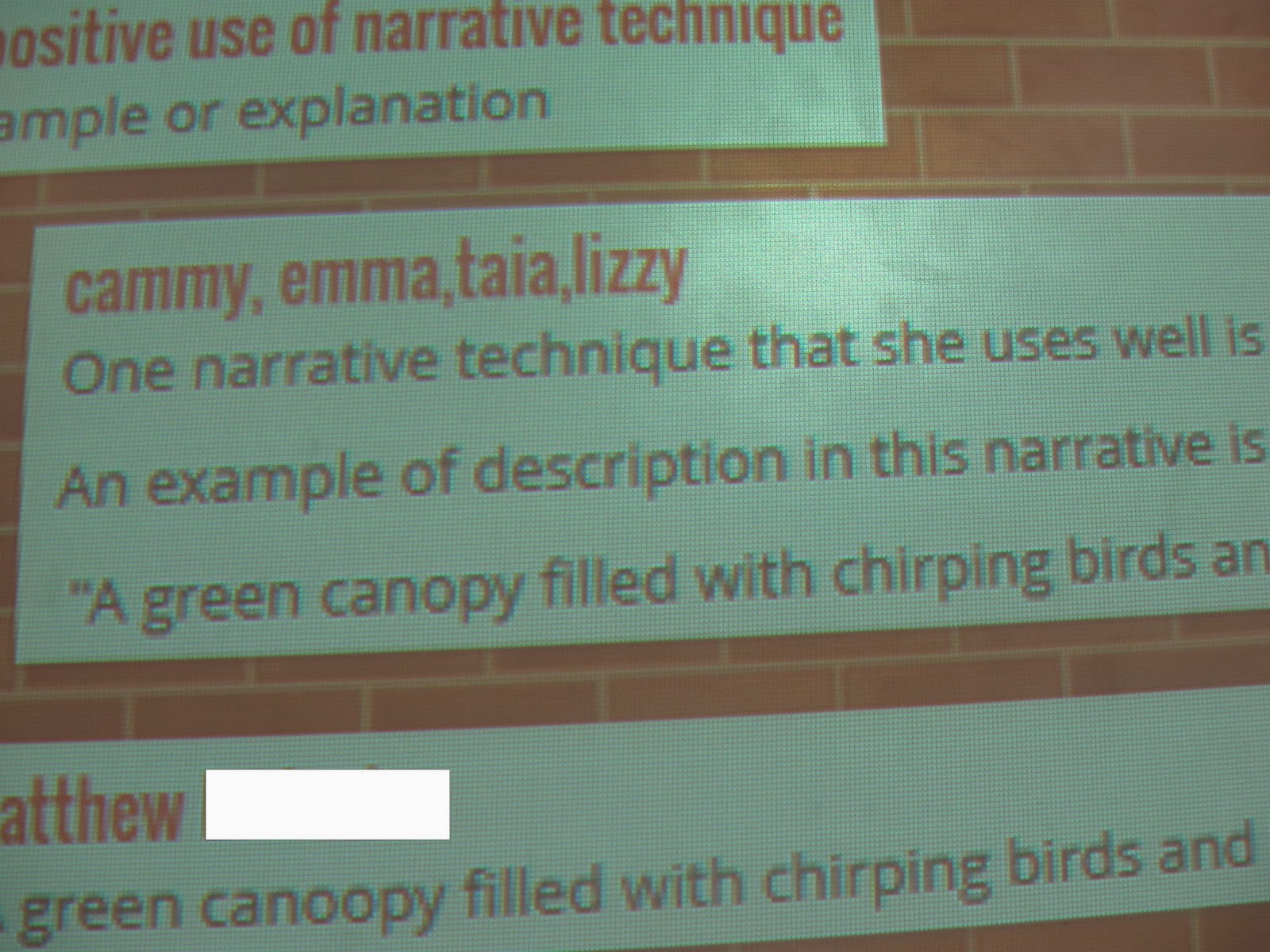
The next step was to send one group member to one of the four computers I have in my room and to use Padlet.com to list their most effective technique and an example or explanation. 


The rest of the group was to go to their own narratives and begin to make notes on what they might add to jazz up their writing.
I felt that every student was very motivated and all students were busily listing what they might add with no exceptions. I think seeing that it could be done, having a mentor text at their level,  and actually experiencing how good narrative technique can be incorporated,  influenced their own insight that they could also do the same in their own writing.
Toward the end of class, I refreshed Padlet on my whiteboard and students could see all responses, which we shared out to the whole class- again making notes on their own narratives as to what they might add. 
A screen shot of one class' contributions


The great thing about Padlet was that I could print or save it as a PDF and actually have more samples of hooks  to use  for future instruction! Less work for me, since the students were the ones who did the discovering and the work in typing them.

Another activity we did was a scavenger hunt for good hooks/effective leads.  We had taken notes in our journals on the types of hooks/leads and looked at and labeled types of hooks I had previously gathered from NPR’s  This I Believe site of hundreds of essays. (I copy the entire introduction, because later we also label the context and thesis statements as well.) 
In our activity, Students had to look through young adult novels and children’s books (that I had and our librarian gathered on a cart for us) and had to list two hooks found and label each with the type of hook.
From there, students participated in a carousel activity where they each had to list one hook on large chart paper that had been labeled with the types- they had to find the appropriate labeled chart paper and write their hook down with the title of the book. (We had some good conversation on citations, use of quotation marks around exact words and how to punctuate a book title). 

Next step, you guessed it! After sharing out to the whole class, they had to  go to their own narrative and create two types of hooks for their own- each labeled with the type of hook. I was thrilled with some of their creations- Devon created this one:  “I couldn’t believe he had bit me. Again!” 

By reviewing the hooks, I was able to see who was getting it and who was not and put smileys by really effective hooks to help students decide on which one they would ultimately use.
I include this activity not just because it is a narrative activity, but because Padlet could have easily been used for this activity as well.
Incorporating technology and student discussion is easy when you have a well-developed plan and a tool like Padlet at your fingertips (for free!)

Wednesday, June 19, 2013

Evidence in Writing

I attended a Common Core Academy held by a local writing project and participated in two noteworthy activities that involve prior knowledge and supporting evidence. The below activities are not my own creation and were generated through a group of teachers and administrators.


In this activity we were asked to read from a children's picture book and the challenge was to find or "lift a line" from the text that supported a character analysis. The character "X" is resilient. Find something in the text that supports this character trait. In small groups, we each read the story and worked to find something in the story that would support this character trait.  As we placed our evidence up for all to see, the instructor led us through a mini-lesson on the types of evidence one might find in a story- dialogue, quotes, inference, etc.  This would work very well for middle grades using a higher level text. Character analysis, evidence of theme, etc. might be the focus and students work to lift a line or find evidence that supports a particular theme or character trait.  I can see using this method to discuss writer's craft and how a writer helps the reader get to know the character- through dialogue, action, what others say about him/her, etc. What do we know about this character? What is he/she like? Lift a line that portrays who this character is as a person. A mini-lesson can follow where you discuss how a writer introduces and develops a character.


I wish I could turn this picture around- I actually did so in Paint, but now it comes up like this anyway...sigh...

Nevertheless, in this activity a topic was introduced- what do you know or think you know about proper nutrition? In small groups we listed everything we thought we knew about this topic. Next we were given multiple articles- they were short and in some cases excerpts- and our goal was to find evidence that supports at least one thing we wrote down on the chart paper. We had to list the evidence and source on a post-it  and place the Post-it next to the line which it supported.

I can see this working for many topics, it can help students achieve those short research projects noted in the CCS, and it can assist in learning how to find evidence and how to cite it.

 In addition, one might use this activity in order to counter-argue as well. If students find information that is the exact opposite of what has been listed, you might color-code your Post-its and use hot pink for example to show evidence that does NOT support that information. A counter-argument mini-lesson or even how to introduce a counter-argument mini-lesson might come from this extension.

Saturday, June 15, 2013

Argumentative Writing: A Pre-write Activity


Pre-Writing  Activity 
Argument (although could work for Informational writing too!) 
CCS: W8.1; 8.4; SL 8.1

When students began to think about their first argumentative piece, convincing our Site-Based Council to allow cell phone use in the classroom, I knew that many students might struggle with three or more sound reasons for allowing cell phones in the classroom. We read many articles about how other schools were using cell phones as well as articles that listed pros and cons on the issue. I decided I wanted a more collaborative approach to developing possible points and here is what we did. 

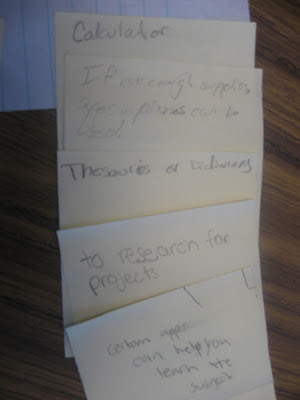
Students were given about 4 post-its and on each were directed to list a possible use for cell phones and/or reasons for having a cell phone. Students worked independently to list at least 3 or 4- one per post-it. 

Once completed, students were put into groups of 4 or 5 and they were directed to share their ideas. 

The next step was then to come up with categories for these ideas (safety, tools, etc.) and to place their post-its in the appropriate category. Students had to come up with their own categories and while most did well, I moved about the room offering advice if needed. 

Students collaboratively organizing their ideas


Students Have organized their ideas into three categories or points

Here students have categorized many of their ideas into a "Tools" category


Students organizing their ideas into categories


Once finished, students shared out their categories and what "points" fell into each category.  

My hope was that students would understand that many ideas can fit into a category, which in turn will produce a "FAT" paragraph. Often times students end up creating points that are very similar and they repeat information. By using this technique I was hoping that students would have the opportunity to think critically about brainstorming ideas, categorizing those ideas, and organizing them from least to most important. All of these skills are needed to write a cohesive argumentative piece.