Showing posts with label elements of literature. Show all posts

Saturday, November 9, 2013

Narrative Mini Lessons and Padlet


My Students are wrapping up their study of Narrative and Style which includes Narrative technique. Typically I focus on developing effective hooks, including context and a thesis in their introduction, and narrative techniques including show don’t tell, dialogue, etc. 

One activity I do each year includes reading a distinguished narrative to identify effective narrative techniques and a scavenger hunt for hooks. 

In October, we held our first On-Demand Scrimmage with two narrative prompts from which to choose and write in a 40 minute period. I had the extreme joy of reading all 130 of them during Fall break and from that reading, was able to select one narrative that was distinguished in its use of narrative technique (show don’t tell, dialogue, effect hook and thesis, strong word choice, etc.)

Once we returned I put students in small groups of 3 to 4, with a copy of that narrative (with student permission and name deleted) and their task was as follows:

  • ·         Each member is to list one narrative technique that was done well with example.

  • ·         Together, justify the distinguished score using the writing scoring rubric.

They had to share the one technique they each listed on their own paper and then come to a consensus on which one they felt was the most effective and why.  They also had good conversation as to why the narrative was a distinguished, which opened their eyes to key words on the rubric that indicate narrative techniques one might use. 

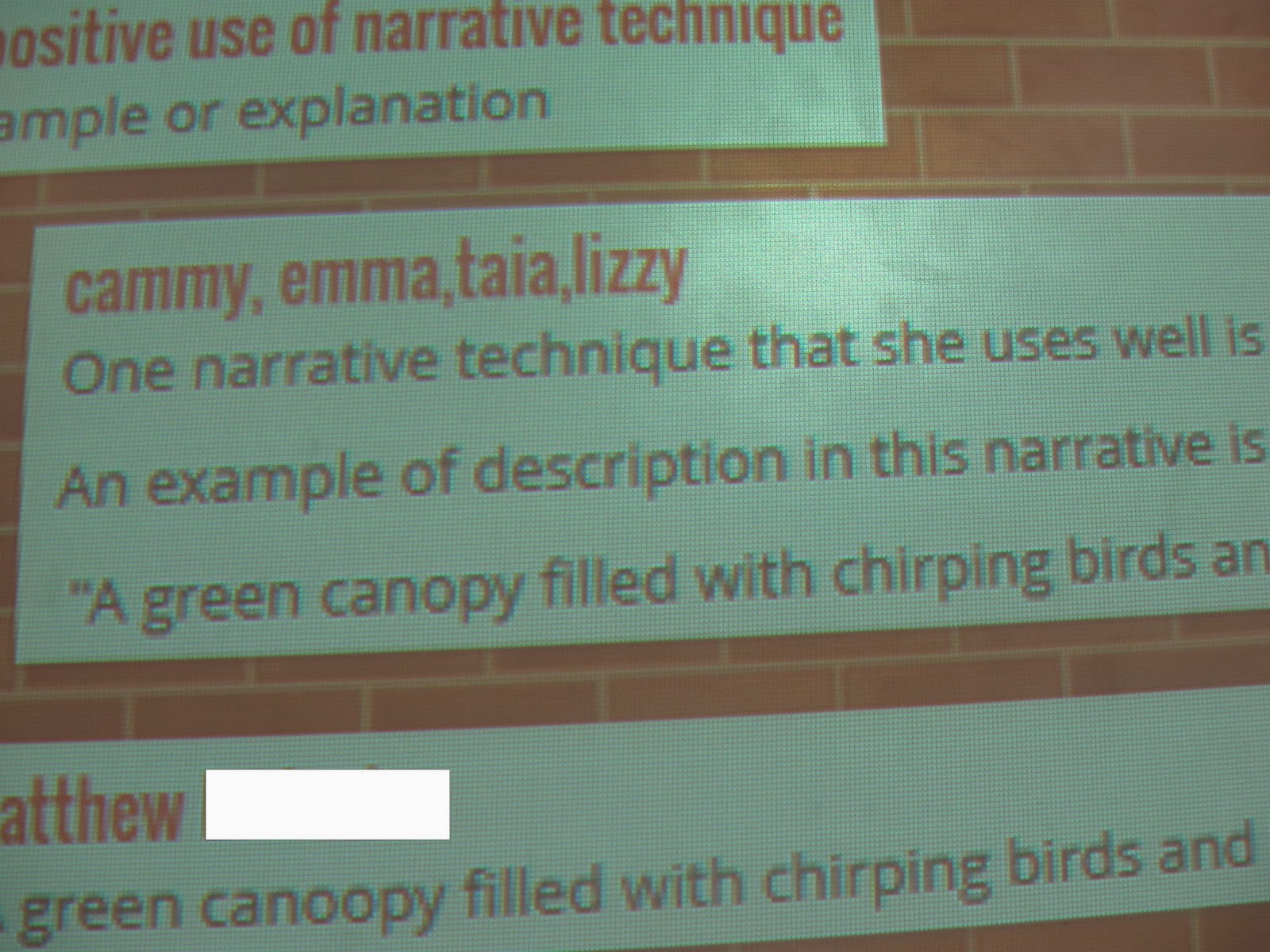
The next step was to send one group member to one of the four computers I have in my room and to use Padlet.com to list their most effective technique and an example or explanation. 


The rest of the group was to go to their own narratives and begin to make notes on what they might add to jazz up their writing.
I felt that every student was very motivated and all students were busily listing what they might add with no exceptions. I think seeing that it could be done, having a mentor text at their level,  and actually experiencing how good narrative technique can be incorporated,  influenced their own insight that they could also do the same in their own writing.
Toward the end of class, I refreshed Padlet on my whiteboard and students could see all responses, which we shared out to the whole class- again making notes on their own narratives as to what they might add. 
A screen shot of one class' contributions


The great thing about Padlet was that I could print or save it as a PDF and actually have more samples of hooks  to use  for future instruction! Less work for me, since the students were the ones who did the discovering and the work in typing them.

Another activity we did was a scavenger hunt for good hooks/effective leads.  We had taken notes in our journals on the types of hooks/leads and looked at and labeled types of hooks I had previously gathered from NPR’s  This I Believe site of hundreds of essays. (I copy the entire introduction, because later we also label the context and thesis statements as well.) 
In our activity, Students had to look through young adult novels and children’s books (that I had and our librarian gathered on a cart for us) and had to list two hooks found and label each with the type of hook.
From there, students participated in a carousel activity where they each had to list one hook on large chart paper that had been labeled with the types- they had to find the appropriate labeled chart paper and write their hook down with the title of the book. (We had some good conversation on citations, use of quotation marks around exact words and how to punctuate a book title). 

Next step, you guessed it! After sharing out to the whole class, they had to  go to their own narrative and create two types of hooks for their own- each labeled with the type of hook. I was thrilled with some of their creations- Devon created this one:  “I couldn’t believe he had bit me. Again!” 

By reviewing the hooks, I was able to see who was getting it and who was not and put smileys by really effective hooks to help students decide on which one they would ultimately use.
I include this activity not just because it is a narrative activity, but because Padlet could have easily been used for this activity as well.
Incorporating technology and student discussion is easy when you have a well-developed plan and a tool like Padlet at your fingertips (for free!)

Sunday, August 18, 2013

Using Picture Books in Middle School Writing


The Common Core State Standards ask for more rigorous reading and writing, but does that discount use of picture books in classroom instruction? I say, absolutely not. The simple fact is that mentor texts are often hard to come by. We have a variety of abilities in each class, and writing is often looked at as, well, boring. At our fingertips, we have material that is interesting and colorful, pulling in the disinterested; we have mentor texts that start at a basic level (although you will see that many picture books are not so “basic” after all), providing a place to begin for all students and providing success from the start.


Personal Writing


Any of Patricia Polacco’s books are excellent mentor texts for personal writing, as well as examples of  development of character, conflict, setting, etc.  Before diving into more complex mentor texts, try using one of her picture books as a mentor text. Two that come to mind right away include Mr. Lincoln’s Way and Thank You Mr. Falker. Both books are excellent examples of memoirs as well as a personal story revealing a change in the major character.


First off, both books offer great “Hooks.”

Mr. Lincoln’s Way: “Mr. Lincoln was the coolest principal in the whole world, or so the students thought.” Students can discuss how the first sentence/paragraph “hooks” a reader, then go on a scavenger hunt through other picture books or young adult novels to find other interesting ways authors start their works. As a higher level activity, students might then categorize the hooks they found, sharing out as a whole in the class to create a class chart that lists types of hooks and examples. Students can also use predicting skills to reveal what they think will occur or what the story will be about as a result of the first “hook” or lead line.


Secondly, both books offer some great figurative language/language usage.

Thank You Mr. Falker: “Knowledge is like the bee that made that sweet honey, you have to chase it through the pages of a book!”

As you can see, this simile is pretty deep and not something that an elementary student may readily grasp. But middle school students have the ability to delve into the meaning of this simile and to uncover its meaning. Polacco’s books are loaded with figurative language; students can use them to go on a scavenger hunt and to work with partners to uncover the meaning.


Finally, both books offer thoughts and feelings and use of dialogue.

It can be difficult to teach dialogue, but in picture books that use this element, students find it easier to grasp- how the dialogue is used to move the story along, how the dialogue is formatted and punctuated, etc. All can be investigated through Polacco’s picture books. In addition, when writing a personal piece, thoughts and feelings is a crucial element. Polacco’s Thank You Mr. Falker, is full of thoughts and feelings. The teacher might provide excerpts and have students highlight those thoughts and feelings, revealing how and where they are used, as well as to what extent they are used throughout the story.


Other Picture Books I Love:

Why Mosquitoes Buzz in People’s Ear by Verna Aardema

I love to read Pourquoi tales- stories about the origin of an animal’s coloring, size, etc. In the seventh grade, students read Pourquoi tales, starting with the mosquito book, and we developed our own. They were imaginative and fun to read!


Zin! Zin! Zin! A Violin by Lloyd Moss

Introduce this book when studying onomatopoeia! It is full of sound words that students can respond to – highlighting them in excerpts, holding up a hand when they hear one, etc. Students can practice their own onomatopoeia in like fashion.


Nothing Ever Happens on 90th Street by Roni Schotter

I love this book at the start of the year. Students always cry about having “nothing to write about.”  As I read, students list each piece of advice that is given to the main character as she searches for something to write about.  For example, “Try to find poetry in your pudding,” Mr. Morley said softly. “There’s always a new way with old words.”  Students can work in partners to decipher what each character meant and how it applies to our writing.

Students also list what the main character thinks as events occur that prompt her to write:  “What if? What might happen next?” Etc.


Abbie Against the Storm by Marcia Vaughan

One of my absolute favorites is a true story of a young girl and a lighthouse, depicting heroism. I love this because it shows that even kids can be heroes. This book is rich in figurative language, strong verbs, dialogue, thoughts and feelings and use of adjectives.  Beyond that, it is a fast-paced story with strong character development, conflict and setting. Students can choose a character trait for Abbie and find quotes that support; students can identify strong verbs or pull out figurative language and decipher the meaning. This book is also a great book to graph on a plot chart; a simple start before moving on to more complex text.  Students might also partake in an exercise involving setting. Why is the setting important to the story? What if the setting were elsewhere? How would it change the story? Students might take the challenge, and create their own story of Abbie in a different setting.


I love picture books in  the middle school! They simply are the most interesting forms of literature that provide excellent mentor texts for writers, can provide examples of various elements of literature through mini-lessons, and instill motivation and success by starting “simple.” You will find, however, that there really is nothing “simple” about picture books; they reach into our imagination and spark our motivation quicker than any black text on white paper.

Note: Picture book images taken from Amazon.com 
Check out Other Picture Book Ideas in the SDAWP #113 Texts Initiative- http://www.sdawpvoices.com/link-up-113texts-mentor-text-challenge-august-link-up/